

Anti-viral with Alicia Kennedy
"People just want you to talk about yourself"

Escape the Algorithm is a newsletter about taking control of our attention and finding a more human side of the internet. After you subscribe, you can make me feel supported by performing a tiny act of codependence: mail me a gift or a postcard, take me out for coffee in person, contribute a story to the newsletter, or become a paid subscriber. Learn more about becoming a ᵐⁱᶜʳᵒsupporter.
Since we last spoke: my essay “The New Turing Test” was included in the Internet Phone Book, now in its (sadly sold-out) second reprint through Metalabel, and I spoke to Willa Paskin about artisanal white noise for Slate’s Decoder Ring podcast.
You haven’t heard from me in a little while because I was spending time with a longer term writing project(!) as well as my new baby(!!).
Today I’m excited to debut Anti-viral, a new series where I talk to creatives about the meaningful work that algorithms overlook, and what they would do more of if attention was no object.
My first conversation is with food and culture writer Alicia Kennedy. She writes the newsletter From the Desk of Alicia Kennedy, and is the author of No Meat Required. Her forthcoming book On Eating: The Making and Unmaking of My Appetites will be out in April.
What’s your relationship with the Algorithm?
Complicated. I love the internet. The meme that’s like, “Ever since I was young I knew I wanted to be on the computer” — that is me. So it made sense that I made my career in digital media. I had this very utopian, idealistic relationship to the internet when I was younger.
It’s degraded over time. The algorithm becoming the mode of finding other people has made it unpleasant to be online. It’s hard to detach because most of my money comes from paid subscriptions to my newsletter or people signing up for workshops that I teach. I have to try to sell those, and those are the hardest things to get eyeballs on.
It creates an agitated relationship with the internet. I don’t do brand deals, which is how most people — especially food people — make money. I find it harder and harder to be seen without having to be abnormal about it, playing a game to make people see me when they’ve already opted in.
I find it very depressing that I’m not supposed to appeal to my own audience. I’m supposed to appeal to everybody. I don’t appeal to everybody, and I never wanted to.
What is something you’ve worked on that’s meaningful to you but didn’t succeed in the marketplace of attention?
Every time I do an interview.
I did over 100 episodes of a podcast. I’ve done a series called How Do You Eat, where I asked people in different cities around the world how they get their groceries. Food media is often aspirational, and I think we can learn a lot from talking to people about their daily life.
Now I do a Salon series where I talk to different food/culture writers or other people that make stuff. I had a panel on whether cookbook criticism is possible. I had two great cookbook authors talk about plant-based recipes for the holidays.
They do well with my core audience. But I’ve found that it’s really difficult to get people’s attention for an hour-long conversation about someone’s book, and that’s depressing to me.
It’s hard to convert — to use the newsletter business word — the free people to paid people without appealing to them with something very digestible. I had the most paid subscribers when I was publishing recipes regularly. Deciding that I would not do recipes regularly but would instead focus on more community-oriented and conversational things was a big shift.
I’m trying to break down the perceived walls that people have. If you can hear an author talk about what it was like to research and investigate their book and what the financials were, demystifying this whole world while bringing people into contact with authors — especially folks who live outside of major urban areas — that feels important.
The individualization of media means there was so much attention on me. The way for me to feel like I was opening up my world was to talk to people in spaces that were not a TikTok or Instagram video, but where people have chosen to come specifically to have these conversations.
That has proven more difficult to make appealing than just publishing recipes or just publishing screeds. People love a screed. They love a polemic. And I can’t do a polemic every day.
If I am putting things out in the world, I want to feel confident that there’s something decent about them. I would rather focus on having conversations and reading books and sharing things with other people than making a living off my righteous rage — which I could do, I know that would be possible, it’s just not appealing to me.
When you say that the status quo draws people toward more individuated, personality-driven work, what do you think is causing that, both culturally and mechanically?
Platforms in general make you focus on individuals. And then the shifts in platforms and algorithms mean your visibility is suppressed if you share links. I want to share other people’s work and books. But I save that energy for my newsletter because if I post it on the semi-public web, it’s going to get suppressed. Fewer people will see my stuff.
So the mechanics of the platforms and the algorithms force you to be selfish. If you start sharing other people’s work, fewer people are going to see your work. It becomes this self-perpetuating cycle of self-centeredness.
It’s also this individualized system of attention where people really latch onto an individual creator. I’ve had people say in event spaces that they buy cookbooks because they like the person online.
People will buy the book simply because you please them on the internet, and that’s terrifying to me. It’s antithetical to how I’ve thought about being a journalist and a writer in the world. The platforms feed into it, but people have been really eager to go this route. They don’t question it. They say, “Oh, this is how I get ads for olive oil from different people I follow. That’s how I figure out which olive oil to buy.”
Brands know this. I feel it very strongly working in food. If you reject, say, the ethos of Graza olive oil and you don’t share the Graza or have it on your counter, you’re alienating yourself from something you could be making money from.
People are unwilling to question how much they love that parasocialness and whatever it alleviates in them. They’re deeply uncritical of that. I think that’s very strange.
I want to follow people who are going to alert me to cool stuff: good movies, good books, good music, cool clothes. I have a very boring lifestyle-magazine approach to what I want from being online. I want it curated; I want an editorial perspective.
I’m used to hearing the critique that platforms suppress people sharing their own stuff. But what you’re saying is even more problematic: that it promotes fundamentally antisocial behavior where people can’t engage with each other’s work. Or when they do, it’s at this performative, brand-pandering level.
In the food media and culture space, which aspects of this feel new and which feel like they’ve been around for a long time?
Going back to James Beard and Julia Child and Martha Stewart and Ina Garten and Giada De Laurentiis and Rachael Ray, food has always been ripe for personality-driven attachment.
But with fragmentation and algorithm-driven social media, it’s gotten weirder. You have so much access to people, and they’re advertising directly to you. Even if you’re a food person, you might be advertising clothing to people. You’re advertising an entire aesthetic, which isn’t new, but it’s much more direct.
When Martha Stewart went to the courtroom, she had an Hermès bag, but she wasn’t advertising Hermès to you directly. Now, because of social media, you have to be selling at every stage, every aspect of your being. The fork and the sweater and the plateware and the olive oil are all for sale.
I think it’s dangerous because it gives no room for honesty in food media and critique. Recipe people occupy a completely different space from anyone who would be critical.
There’s this algae oil. Everyone’s using the algae oil now. Nara Smith did a collaboration with the algae oil.
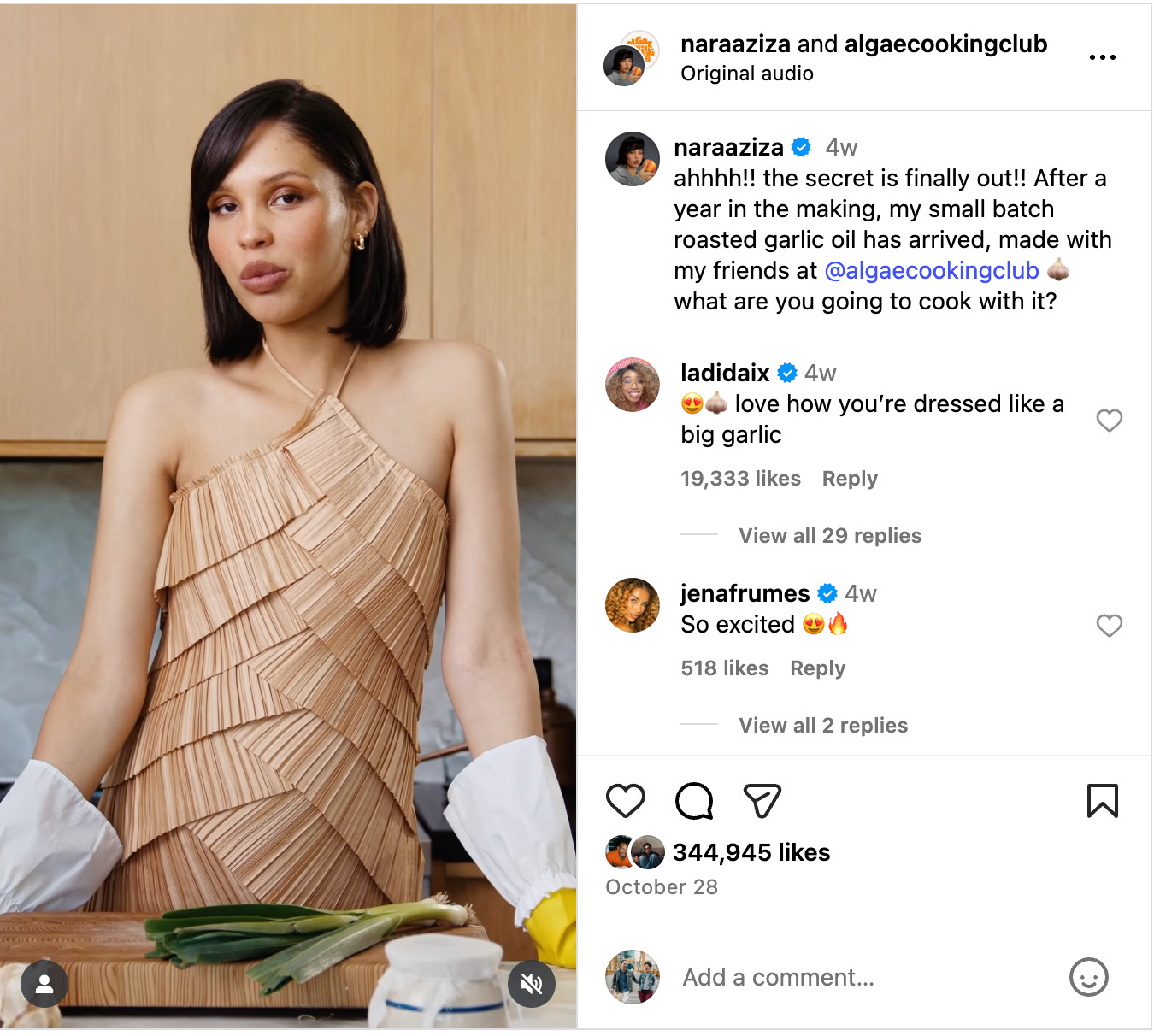
There’s not even one inkling of curiosity about how algae oil is getting made and bottled. The only place you’re reading about it is maybe Bloomberg or the Wall Street Journal, that no one in food has read. It’s this individualized, uncritical, “everyone has to be happy and love each other” machine that cuts off any possibility of real conversation in food. You can’t say anything bad, and if you ask a question you’re being mean.
I’ll tweet about a chef who is against ending the tipped minimum wage, for example, and I’ll get a death threat in my inbox. People think they have a personal relationship with that chef or recipe developer.
There’s no room anywhere in this system to give a critique. Food media has shrunk the way all media has shrunk. It’s everyone fending for themselves. It’s not like Bon Appétit is going to go deep on the algae oil. No one does any reporting anymore.
It seems like there’s a line to be drawn from this desire you have to capture conversations, which are inherently relational, to what I think of as one of your central projects, which is refocusing attention in food away from just escapist content — recipes and restaurant travel logs — towards food systems. In both cases the system is constantly shunting attention back toward the individual.
Yeah. And the buying.
And the buying, yes. What’s interesting though is that even when your work touches on the personal, I think of your camera as primarily facing outwards towards systems. The implication of what you’re saying — which I see as almost tragic — is that no matter what you do the audience is always going to turn the camera back at you.
Yeah, absolutely. People love it when they feel like they’re getting a piece of you personally.
I’ve had comments from people saying, “I was wondering if you would ever write explicitly about your mixed identity. Will you write explicitly about being childfree?” (which is a label I’ve never taken for myself).
If these things make their way into a piece, it’s going to be because I’ve done a lot of work on them, not because I’m writing some xoJane-style “This Is Why I’m Childfree” post. I really push back on that easy discourse type of writing because I find it facile, banal, boring, speaking only for clicks and likes. It’s so antithetical to what I wanted to do with my life.
I can see in the data that people just constantly want you to talk about yourself. But they don’t like it if you turn the mirror and say, “What you want from me is parasocial bleeding out onto a page.” But it is what they’re after.
I’ve even had the thought: “If I had a kid, people would really like that.”
That’s dark.
It’s so dark. But I’m like, “Oh, people would like that. It would make me legible and softer to them in a certain way.”
This is almost the tritest example of this, but in your piece “The Algorithm of the Mind,” you wrote that Instagram showed your selfie to more of your followers than it has ever shown any of the work that you do. That was about the cult of personality among those accounts already following you but not yet paying or subscribed. But there’s also this circle beyond that — the TikTok and Instagram Reels environment — where people are suddenly scrolling into something you made with no idea who you are and maybe no interest in who you are. What do you make of that aspect of the ecosystem?
It’s terrifying. To appeal to people who don’t know anything about you… I’ll never take off on Reels beyond my own followers because I don’t let people comment if they don’t follow me. That’s to save my sanity from bad-faith lunatics.
I also don’t let people DM me who I don’t follow. I shut off story replies when I was on vacation; I think I’m never going to turn them back on. I use Opal to block social media most of the day. I have a ton of boundaries in place so that I’m using it as data, not as a way of losing myself or getting too attached.
When I was posting pictures from my trip to Copenhagen, I realized that if I was like ”Here’s where I ate in Copenhagen as a food writer,” and then posted the images, that would have done better than me just posting my photos. But I don’t want to do that. Why am I trying to appeal to people who wouldn’t really like my work anyway but do want easy, consumptive food content?
It’s depressing to know what I could do to appeal to people outside the realm of those who already know who I am, and to refuse to do it.
The closest I’ve come recently is making some Reels. I made one when Eleven Madison Park — a fine dining restaurant in New York that had gone vegan and then went back to serving meat this year — made that switch. It got me a lot of followers and decent views. I can’t manufacture that kind of shit every day.
What the algorithm wants is for me to feel frazzled by the need to perform that expertise on a daily basis.
What would an internet look like that valued this kind of more critical, more systemic, more community-oriented work more highly?
Oof. I don’t even ask for much. The mediation has always been there — it’s not like Twitter in 2008 was good and neutral — but I miss finding people and ideas without being fed them. I miss when being on the internet felt like flipping through a magazine: “Let me see what’s over here.”
Substack means anyone can start one of these blogs, including Lizzo and Charli XCX. That’s cool to an extent. At the same time, because of the way it works, of course Charli XCX is going to get more attention than a 22-year-old who just graduated from NYU, even if that 22-year-old is doing really good work. No one will see it.
It’s really hard to find it unless they decide to write something freaking weird about plastic surgery or gender politics. The ways to get attention are so obvious: already be famous, say something outrageous, or be appealing in the same way as everyone else who’s ever become famous.
It’s hard to imagine getting back to a time where — I don’t think the internet was ever a meritocracy — but where discoverability of people’s work and ideas was possible in a way that I don’t think it is anymore.
The only way I find people to read anymore — and I hate it — is if they read me, and then I start reading their work because they’re commenting or sharing. I find more new stuff in actual magazines now. I’ve gone full circle: the internet is no longer a way for me to find new stuff, it’s just a place where stuff is.
The Frieze magazine gift guide I really like actually. It actually shows me new shit I could get into. Last year it introduced me to Worms Literary Journal in the UK. The internet is never going to show that to me.
It sounds like you want more work that is contextual and curated, where in order to enter a particular world, you consciously have to decide to go to that world, and it’s a world shaped by actual people. Instead of things being inserted in random order based on opaque incentives.
Yes. That’s what I miss about my youth.
Even on LiveJournal, people had tags. Going back to AOL profiles, where you could search for people who liked the same bands as you or the same authors — even that felt more human than the way we use the internet now. In my early 20s, from being on Twitter or reading the alt-lit blog HTMLGiant, I started to copyedit different literary magazines. I found people that way, did work that way, made connections that way. It was so much more organic. People were putting things out in the world that were real.
Now it’s so hard, especially because money is… it used to be easier to live. The incentives are different because it costs so much to do anything normal. The stakes are different for everything you do, even if it’s just posts on the internet.
To tie this back to our conversation about conversations…that’s part of why I interview people: it’s interesting for my readers, but it’s also an excuse for me to engage with people whose work I admire. I’ve made friends and found collaborators through this format. It’s unfortunate if that’s not what people want.
Exactly.
If people don’t actually want — I’ll use the word “authentic” — people authentically engaging with their colleagues’ and friends’ work, then what do they want?
The relational aspect of it — the book club, the events, the Discord — is that people don’t want to have a stake. People talk about the loneliness epidemic, but I think people can be afraid or intimidated even by the idea of showing up to a book club.
I just want to cultivate the space that I actually want in the world. Whether people are into that or not is up to them. The challenge is figuring out how to make it enticing without giving my soul up to the algorithm gods.
There’s risk, but there’s also reward. At the last book club I ran, two people found out they live close by, went out and hung out, and now they’re friends. That’s the kind of thing where I’m like: okay, this is why I’m doing this.
Escape the Algorithm is a newsletter about taking control of our attention and finding a more human side of the internet. After you subscribe, you can make me feel supported by performing a tiny act of codependence: mail me a gift or a postcard, take me out for coffee in person, contribute a story to the newsletter, or become a paid subscriber. Learn more about becoming a ᵐⁱᶜʳᵒsupporter.
This resonated so much! Love this new series idea!
Glad ETA is back! This was a great interview